

Table of Contents
- What Ethically Sourced Coffee Actually Means
- How to Identify Ethical Coffee Labels (Without Getting Fooled)
- Direct Trade vs Fair Trade Coffee: What's the Difference?
- The Real Impact on Farmers, Communities, and the Environment
- Ethically Sourced Coffee Brands: What to Look For
- Does Ethical Coffee Cost More? A Budget-Friendly Approach
- Conclusion: Every Cup Counts
- Frequently Asked Questions
Last Updated: September 12, 2026
What Ethically Sourced Coffee Actually Means
Ethically sourced coffee is coffee produced and traded under conditions that protect farmers, workers, and the environment, with verifiable accountability at each step from farm to roaster. At Paws and Promise Coffee, we treat that definition as a starting point, not a marketing line.
The core idea is straightforward: the people who grow coffee should earn enough to live on, work in safe conditions, and farm in ways that don't destroy the land their children will inherit. In practice, "ethically sourced" gets stretched to cover almost anything, which is why the details matter more than the phrase itself.
The Core Principles Behind Ethical Sourcing
Four principles separate real ethical sourcing from a label slapped on a bag:
- Farmer compensation: growers earn a living wage, not just a market minimum
- Traceability: the roaster can name the region, cooperative, or farm
- Environmental stewardship: farming practices protect soil, water, and biodiversity
- Labor rights: no forced or child labor, and safe working conditions
When a roaster can speak to all four, you're looking at supply chain transparency rather than a slogan.
How to Identify Ethical Coffee Labels (Without Getting Fooled)
The fastest way to identify ethical coffee labels is to check whether a third-party certifier verifies the claim, not the roaster's own packaging. Self-declared "sustainable" or "responsibly sourced" stamps mean nothing without an independent audit behind them.
Look for certifications with published standards and farm-level inspection. A logo alone isn't proof, but a recognizable certification body at least gives you something to check.
Third-Party Certifications That Matter
The certifications worth knowing include Fair Trade, Rainforest Alliance, USDA Organic, and Bird Friendly. Each covers different ground: Fair Trade focuses on price floors and farmer premiums, Rainforest Alliance on environmental and social criteria, USDA Organic on pesticide-free growing, and Bird Friendly on shade-grown habitat. For detail on what each program actually requires, the USDA National Organic Program publishes its standards publicly.
The Greenwashing Trap: When Labels Lie
Greenwashing happens when a brand borrows the language of ethical sourcing without the supply chain to back it up. Vague terms like "natural," "artisanal," or "direct from farmers" are unregulated and easy to print on any bag.
The tell is usually the missing detail. A roaster that can't name the cooperative, region, or certification behind its beans probably doesn't have one. Real traceability names names.
Direct Trade vs Fair Trade Coffee: What's the Difference?
The difference between direct trade and Fair Trade coffee comes down to who sets the standard. Fair Trade relies on a third-party certification with a guaranteed minimum price and a social premium paid to cooperatives (fairtradecertified.org). Direct trade skips the certifier and has the roaster negotiate straight with farmers, often paying above market rates for quality.
Both models can work. Fair Trade gives farmers a floor price and a recognizable guarantee. Direct trade can pay more, but only when the roaster is genuinely transparent about terms. Without that transparency, "direct trade" is just a phrase on a bag.
| Model | Who Sets the Standard | Farmer Benefit | Main Risk |
|---|---|---|---|
| Fair Trade | Third-party certifier | Price floor plus social premium | Premium may be modest |
| Direct Trade | The roaster | Potentially higher prices | No independent verification |
The Real Impact on Farmers, Communities, and the Environment
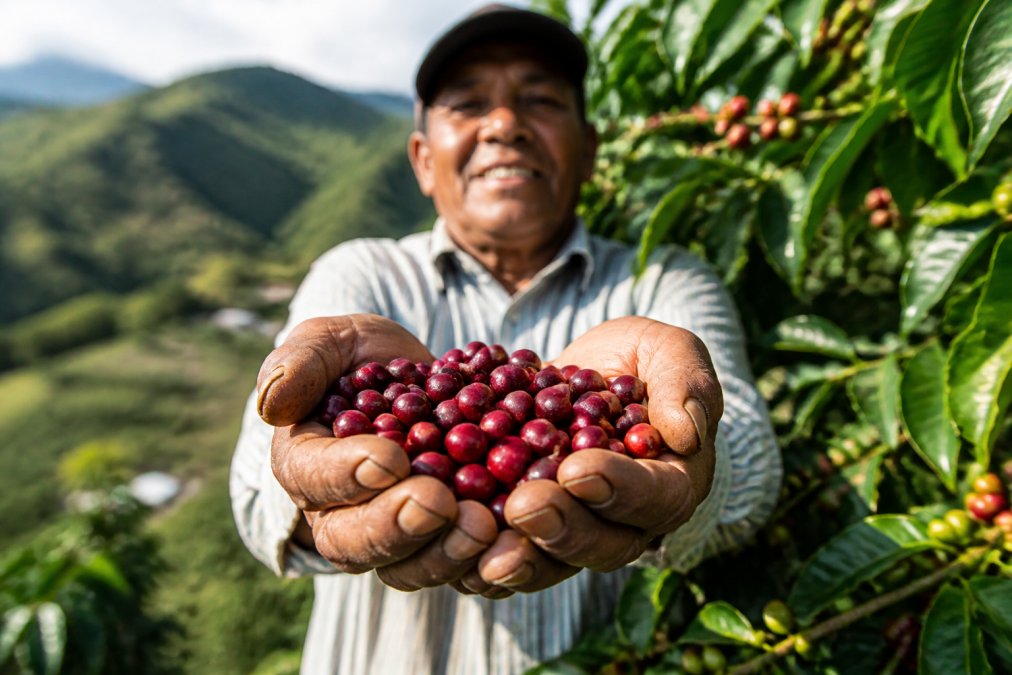
The measurable impact of buying ethically sourced coffee shows up in three places: household income, community infrastructure, and farm-level environmental practices. When farmers earn a living wage, they can invest in their land and their children's education instead of just surviving the next harvest.
Farmer Compensation and Living Wages
Farmer compensation is where ethical sourcing either delivers or doesn't. A price floor keeps growers above the worst of market volatility, but a floor isn't the same as a living wage. The gap between the two is where most certification debates live.
Here's the mechanism most guides skip. Under a Fair Trade model, the buyer pays a published minimum price per pound plus a fixed social premium on top of it. That premium doesn't go to individual farmers, it goes to the cooperative, which votes on how to spend it. Common uses include:
- Cupping labs and quality training, so the co-op can command higher prices next harvest
- Processing equipment, which lets members sell washed beans instead of cheaper dried cherries
- Schools, clinics, and clean water, which reduce the secondary costs that keep farming families in debt
- Emergency funds, which smooth out the bad years that otherwise force farmers to sell land
That's the part of the model that compounds over time. A price floor prevents collapse; a social premium builds capacity. A common pattern is that co-ops with several years of premium reinvestment start negotiating direct contracts at prices above the floor, because their quality scores justify it.
The honest caveat: a price floor is not a living wage. The gap between the two is real, and it's why some roasters pay above certification minimums on their own. When you see a roaster publish the actual farmgate price it paid, that's a stronger signal than any logo.
Environmental Stewardship and Climate Change Mitigation
Shade-grown coffee farms support biodiversity and store carbon in the soil and tree canopy (nationalzoo.si.edu). Pesticide-free growing protects water sources and the workers handling the crop. These practices matter for climate change mitigation because coffee is sensitive to rising temperatures, and the farms most exposed to climate risk are often the smallest.
The mechanism is worth spelling out. A shaded farm keeps a multi-story canopy, taller shade trees over the coffee shrubs, which does three things at once: it moderates temperature swings that stress the plant, it holds soil in place on steep slopes, and it gives migratory birds and pollinators habitat. A sun-grown monocrop does none of those things, and it usually requires more synthetic inputs to compensate.
This is also where the carbon math gets more complicated than most guides admit. Coffee's footprint isn't just on the farm. It includes:
- Fertilizer and pesticide production, which is energy-intensive
- Processing and washing, which uses water and, in some methods, significant fuel
- Ocean shipping, which is comparatively efficient per pound but not free
- Roasting energy, which happens close to you and is often the single largest post-farm emission source
- Packaging and last-mile delivery, which varies wildly by format
So a bag can be certified shade-grown and still carry a heavy footprint if it's roasted in a gas-fired plant and shipped in small quantities. The takeaway isn't that certifications are meaningless, it's that farm-level ethics and total carbon footprint are two different questions, and a genuinely sustainable roaster should be able to speak to both.
Sustainable agriculture isn't just an environmental argument. It's a supply chain argument. If the growing regions become unviable, everyone in the chain loses, and the smallest farms lose first.
Ethically Sourced Coffee Brands: What to Look For
The best ethically sourced coffee brands share a few habits: they name their origins, publish their sourcing standards, and can explain where the money goes after the sale. If a brand can't answer those questions, the ethical claim is decoration.
At Paws and Promise Coffee, we roast to order and donate 10% of every sale to support Forever Paws Animal Shelter and Sweet Inspirations' supportive employment programs in Milford, MA. Our single-origin offerings, like the [Colombia(/products/colombia) single origin | pawsandpromisecoffee.com] and Honduras Marcala coffees, name the region and cooperative behind the beans. That's the transparency test in practice: you can trace the cup back to a place and a group of farmers.
Does Ethical Coffee Cost More? A Budget-Friendly Approach
Ethical coffee often costs more, but the premium isn't as steep as people assume, and there are ways to buy well without overspending. The price difference usually reflects a higher farmgate payment, certification fees, and smaller-batch roasting.
Where does the extra dollar actually go? A rough breakdown of the premium on a certified bag typically covers:
- A higher payment to the farm, which is the point of the exercise
- Certification and audit fees, paid annually by the cooperative and the importer
- Separated logistics, because identity-preserved lots can't be commingled with commodity beans
- Smaller roast batches, which carry higher per-pound energy and labor costs
None of that is waste. But it does mean the cheapest certified bag is rarely the most ethical one, a rock-bottom price usually means someone absorbed the premium, and it's rarely the importer.
How to Support Ethical Coffee on a Tight Budget
Budget-friendly ethical consumption comes down to a few moves that actually change your cost per cup:
- Buy whole bean and grind at home. You get more cups per dollar and better freshness. Pre-ground coffee stales faster, so you brew more of it just to taste it.
- Choose a subscription or bundle. Our [Daily Brew Starter Pack(/products/the-daily-brew-starter-pack) | pawsandpromisecoffee.com] pairs a 12 oz bag with a mug for $39.99, which spreads the cost across a gift or a first order.
- Skip the single-serve markup when you can. Pods cost more per cup than whole bean, though they trade convenience for that premium.
- Buy from roasters who roast to order. Fresher coffee means less waste from stale bags you toss.
- Buy smaller amounts more often. A 12 oz bag you finish beats a 2 lb bag that goes stale in the cupboard. The cheapest coffee is the coffee you actually drink.
- Split a subscription with a friend or coworker. Two people on one recurring order often hit free-shipping thresholds and cut per-person cost.
- Treat ethical coffee as a swap, not an add-on. If you're already buying a daily latte, a bag of well-sourced whole bean at home is usually cheaper per cup, not more expensive.
The Honest Caveat
Certified coffee does carry a price premium, and if the budget is tight, buying a smaller amount of well-sourced coffee beats buying a large bag of unverified beans. The goal isn't to buy the most expensive bag on the shelf, it's to make sure the money you do spend reaches the farm. A $14 bag from a roaster that publishes its farmgate price does more good than a $22 bag with a vague "sustainable" stamp and no traceability behind it.
Conclusion: Every Cup Counts
Choosing ethically sourced coffee is a small daily decision with a long chain of consequences behind it, and the hardest part is telling real sourcing from marketing copy. Paws and Promise Coffee roasts to order, sources single-origin beans with named origins, and donates 10% of every sale to Forever Paws Animal Shelter and Sweet Inspirations' supportive employment programs. If you want your morning cup to do more than wake you up, explore our single-origin coffees and taste the difference transparency makes.
Frequently Asked Questions
What does it mean when coffee is ethically sourced?
Ethically sourced coffee means the beans were produced with fair compensation for farmers, safe labor conditions, and environmentally responsible farming methods. It often involves direct trade relationships, third-party certifications like Fair Trade or Rainforest Alliance, and supply chain transparency. The goal is to ensure everyone from the smallholder farmer to the roaster benefits fairly. When you buy ethically sourced coffee, you support living wages, community development, and sustainable agriculture.
How can consumers verify if their coffee is truly ethically sourced?
Look for third-party certifications such as Fair Trade, Rainforest Alliance, or Organic. Check the roaster's website for supply chain transparency, including named farms or cooperatives and their locations. Some roasters publish impact reports or audit results. If a brand makes vague claims without verification, treat it as a red flag. You can also contact the roaster directly and ask about their sourcing practices and farmer compensation.
What is the difference between Fair Trade and direct trade coffee?
Fair Trade is a certification system with set standards for pricing, labor, and environmental practices, verified by a third party. Direct trade is a relationship model where roasters buy directly from farmers, often paying above market price without formal certification. Direct trade can offer more flexibility and higher premiums, but it lacks standardized oversight. Both aim to improve farmer livelihoods, though Fair Trade provides more structured guarantees while direct trade relies on roaster accountability.
Does buying ethically sourced coffee really make a difference?
Yes. Ethical sourcing supports farmer compensation, community development, and environmental stewardship. When you choose ethically sourced coffee, you help smallholder farmers earn a living wage, fund local schools and infrastructure, and encourage pesticide-free and organic farming. It also reduces the carbon footprint of coffee production. Every purchase signals demand for responsible practices, pushing the industry toward greater supply chain transparency and social impact.