

Table of Contents
- What Is Greenwashing in the Coffee Industry?
- Common Greenwashing Red Flags on Coffee Packaging
- Vague Buzzwords and Marketing Language That Hide the Truth
- Coffee Sustainability Certifications: What Actually Matters
- Fair Trade vs Direct Trade Coffee: Understanding the Difference
- How to Verify Coffee Supply Chain Transparency
- The Green Premium Trap and Why Ethical Coffee Costs More
- Frequently Asked Questions
Last Updated: September 19, 2026
What Is Greenwashing in the Coffee Industry?
Greenwashing in the coffee industry happens when brands make environmental or ethical claims that sound good but lack real substance. The term describes using vague language, misleading imagery, or incomplete certifications to appear more eco-friendly or socially responsible than the business actually is.
The coffee industry is particularly vulnerable to greenwashing because supply chains are complex, most consumers never visit farms, and sustainability claims are difficult to verify. Brands use words like "natural," "eco-friendly," or "sustainable" without third-party verification, so well-meaning customers pay premium prices for better marketing, not ethics.
Understanding the signs of greenwashing in coffee brands protects your wallet and ensures your purchase supports real ecosystems and farmers' livelihoods.
Common Greenwashing Red Flags on Coffee Packaging
Look for these specific warning signs when evaluating coffee packaging. Greenwashing often hides in plain sight on the front of the bag.
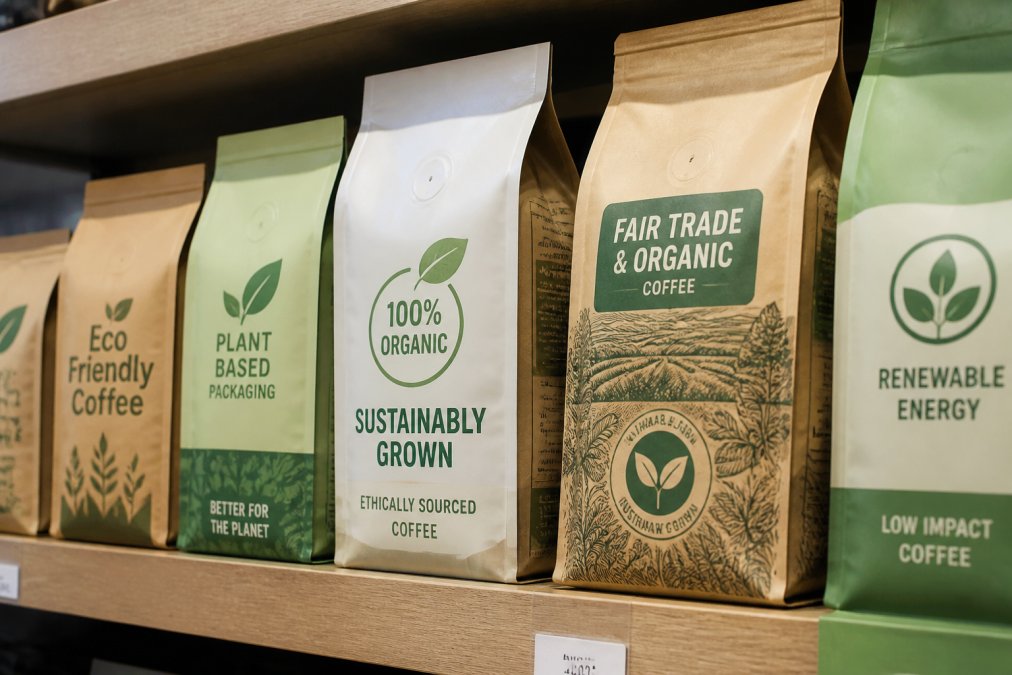
Vague green imagery without certification marks. Many brands use leaf logos, earth tones, or nature photography without proof. A pretty picture means nothing without a certifying body's stamp. Look for actual certification logos from recognized organizations.
Missing origin information. If the bag says "sourced from Latin America" without naming a specific region, farm, or cooperative, the brand is hiding something. Real ethical sourcing includes specificity: "Huila region, Colombia" or "Oaxaca, Mexico."
Absence of farmer or cooperative names. Ethical brands name their suppliers or cooperatives. Anonymous sourcing suggests the brand lacks direct relationships with producers.
No pricing transparency about the supply chain. If a brand claims to be ethical but prices the same as conventional coffee, the math doesn't work, fair wages and sustainable practices require investment.
Vague Buzzwords and Marketing Language That Hide the Truth
Certain words appear constantly on coffee packaging but mean almost nothing without context. These buzzwords are the bread and butter of greenwashing.
"Natural" and "all-natural." These terms have no legal definition in the coffee industry and tell you nothing about farming practices, pesticide use, or labor conditions. Ignore them unless paired with a specific certification like "organic."
"Eco-friendly" without specifics. This is perhaps the most meaningless claim in coffee marketing. Real sustainability claims name the specific practice: "shade-grown," "water-efficient processing," or "regenerative agriculture."
"Sustainable" as a standalone claim. Legitimate brands explain sustainability practices with measurable metrics or third-party verification.
"Fair trade" without a certification number. Some brands use the words "fair trade" without holding Fair Trade certification. If you don't see a Fair Trade logo with a certification number, the claim is unverified.
"Rainforest-friendly" or "forest-safe." These phrases sound environmental but carry no legal weight. They're marketing language designed to appeal to conservation-minded buyers without committing to measurable forest protection.
Coffee Sustainability Certifications: What Actually Matters
Not all certifications are equal. Some require rigorous auditing and transparent supply chains; others are easier to obtain and less meaningful. Many consumers don't verify that a certification is current and legitimate, a critical step.
Fair Trade Certification certifies that farmers receive minimum prices and cooperatives follow labor and environmental standards through third-party auditing. Look for the Fair Trade logo and certification number on the package. To verify: Visit fairtradeusa.org or fairtrade.net and search by certification number or producer name to confirm the certification is active.
Organic Certification verifies coffee was grown without synthetic pesticides or fertilizers through USDA-accredited agents. It protects the environment and farming communities, though it doesn't guarantee fair wages. To verify: Search the USDA Organic Integrity Database (organic.ams.usda.gov) using the producer name. If a brand claims USDA organic but doesn't appear, the claim is false.
Rainforest Alliance Certification focuses on environmental sustainability, biodiversity, and worker welfare through annual audits. To verify: Use rainforest-alliance.org's searchable directory to confirm current certification status and audit history.
Direct Trade is a business model where roasters buy directly from farmers or small cooperatives, often at higher prices and with greater transparency. Without a certifying body, you rely on the roaster's integrity. To verify: Ask for specific farmer names, farm locations, and purchase prices. Legitimate roasters publish this information on their websites.
Bird Friendly Certification ensures coffee is grown under shade trees that support bird habitat, protecting biodiversity. Administered by the Smithsonian Migratory Bird Center. To verify: Check nationalzoo.si.edu/migratory-birds/bird-friendly-coffee to confirm certification.
The verification step most consumers skip: A certification number means nothing if expired, fake, or inactive. Spend 90 seconds verifying before buying. If a brand won't provide a certification number or it doesn't appear in the official database, the claim is greenwashing.
Fair Trade vs Direct Trade Coffee: Understanding the Difference
These two approaches to ethical sourcing are often confused, but they work differently.
Fair Trade is a certification system with established minimum prices and labor standards verified by certification numbers.
How to Verify Coffee Supply Chain Transparency
Take these concrete steps to verify claims and spot visual greenwashing tactics.
Step 1: Decode the packaging design for greenwashing signals.
- Color palette: Earth tones are neutral, but if the entire design is green with no farm photos, origin maps, or farmer names, it's likely cosmetic greenwashing.
- Imagery: Real transparency includes photos of actual farms, farmers, or cooperatives. Greenwashing uses generic nature photography that could be from anywhere.
- Font and language density: Greenwashing uses large, vague words in prominent fonts with minimal detail. Transparent brands pack the back with specific sourcing information, farm names, and certifications.
- Certification logo placement: Real certifications appear clearly with numbers. Greenwashing brands hide logos in corners or use fake-looking seals.
Step 2: Verify origin specificity on the bag itself.
- Vague: "Sourced from Latin America" or "African coffee"
- Specific: "Huila Department, Colombia" or "Yirgacheffe Zone, Ethiopia" or "Cooperative name: Asociación de Productores de Café Orgánico"
- Most transparent: Farm name, farmer name, altitude, harvest date, and cooperative affiliation all on one bag
Step 3: Cross-reference the farm or cooperative name.
- Search the farm or cooperative name online along with the country. Legitimate operations have websites, social media, or appear in agricultural databases.
- Check if the farm or cooperative appears in Fair Trade, Organic, or Rainforest Alliance directories (see the certification section above). If a brand claims to source from a certified farm, that farm should appear in the official database.
- Look for third-party documentation: news articles, NGO reports, or academic studies mentioning the farm or cooperative by name. Established, legitimate operations are documented in multiple sources.
Step 4: Examine pricing transparency and the math.
-
Transparent brands disclose: How much of the purchase price goes to farmers, what certifications cost, what sustainability investments are made.
-
Greenwashing brands hide: The supply chain cost breakdown. They charge premium prices but can't explain where the money goes.
-
The red flag: A brand charges $15-18 per pound (premium pricing) but can't show you Fair Trade certification, direct trade documentation, or any third-party verification. Premium price without verified practices = you're paying for marketing, not ethics.
-
Look for: Specific farm names, farmer stories with photos, cooperative information, pricing models, impact reports, and sourcing maps.
-
Red flags: Website has no sourcing section, uses only generic sustainability language, or provides no way to contact the company with questions.
-
Depth indicator: Brands that publish annual impact reports (showing how much money went to farmers, what environmental projects were funded, how many families benefited) signal transparency. These reports are expensive to produce and audit, so greenwashing brands rarely publish them.
Step 6: Check for third-party audits and impact verification.
- Ask: Does the brand publish annual impact reports? Are they audited by a third party?
- Legitimate direct trade roasters often publish detailed sourcing reports showing farmer names, prices paid, and farm locations.
- If a brand claims to be ethical but publishes no impact data, verification, or audit results, the claim is unverified.
Step 7: Ask direct questions and evaluate the response.
- Legitimate brands: Respond within 24-48 hours with specific information. They provide farm names, certification numbers, pricing details, and are happy to discuss their practices.
- Greenwashing brands: Don't respond, provide vague non-answers, or become defensive when asked for specifics.
- Questions to ask: "What is the name of the farm or cooperative you source from?" "What is the Fair Trade or certification number?" "How much of the purchase price goes directly to farmers?" "Can you provide a link to verify your certification?" "Do you publish impact reports?"
The Green Premium Trap and Why Ethical Coffee Costs More
Ethical coffee costs more. Understanding why protects you from overpaying for greenwashing while ensuring you don't underpay for genuine ethics.
Frequently Asked Questions
What are the most common signs of greenwashing in the coffee industry?
The most common signs include vague terms like 'eco-friendly' or 'natural' with no third-party verification, green imagery and leaf designs that suggest environmental commitment without substance, unsubstantiated claims about sustainability practices, and lack of transparency about where beans come from or how workers are paid. Look for specific certifications, supply chain details, and verifiable information rather than marketing language alone.
How can I verify coffee sustainability certifications are legitimate?
Check for recognized third-party certifications like Fair Trade Certified, Rainforest Alliance, or Organic. Visit the certifier's website to confirm the brand is listed. Research what each certification actually requires, Fair Trade ensures minimum prices and labor standards, while Organic verifies farming practices. Be skeptical of proprietary certifications created by the coffee company itself, as these lack independent verification and accountability.
What's the difference between fair trade and direct trade coffee?
Fair Trade Certified coffee follows established standards set by an independent organization, guaranteeing minimum prices and labor protections across a supply chain. Direct trade involves the roaster buying directly from farmers, often at higher prices, but lacks standardized verification, you rely on the roaster's claims. Both can be ethical, but direct trade requires you to research the specific roaster's sourcing practices and transparency.
Why does truly ethical coffee cost more, and how do I avoid paying for false claims?
Ethical coffee costs more because fair wages, sustainable farming, and supply chain transparency add real expenses. To avoid the 'green premium trap,' compare price to certification level. Red flags include premium pricing without certification or transparent sourcing details. Request information about where profits go; genuine mission-driven brands like Paws and Promise publish how sales support causes like animal shelters and employment programs.
The coffee you buy matters. It affects farmers' incomes, ecosystem health, and the communities where coffee grows. Learning to spot the signs of greenwashing in coffee brands means you can make purchases that actually align with your values. Look for specific certifications, transparent sourcing information, and brands willing to explain their practices in detail. Your morning cup can genuinely make a difference when you choose thoughtfully.