

Table of Contents
- What "Ethically Sourced" Actually Means on a Coffee Label
- How to Identify Greenwashing in Food Brands
- Third-Party Coffee Certifications That Carry Real Weight
- Direct Trade vs Fair Trade Coffee: Which Claim Holds Up
- A Visual Audit: What to Look For on the Bag
- Follow the Money: Importers, Cooperatives, and Farm-Gate Price
- Conclusion: Trust the Details, Not the Story
- Frequently Asked Questions
Last Updated: September 10, 2026
What "Ethically Sourced" Actually Means on a Coffee Label
Ethically sourced coffee is coffee produced under conditions that protect farmers, workers, and the environment, verified through traceable supply chains rather than marketing claims alone, and the phrase "ethically sourced coffee" itself has no legal definition in the United States. This guide from Paws and Promise Coffee explains how to separate real certification from greenwashing, starting with one uncomfortable truth: "ethically sourced" has no legal definition in the United States. Any roaster can print it on a bag.
The words carry weight with shoppers while costing nothing to use. What holds up is documentation: who grew the coffee, what they were paid, and who verified it. Here's how to check all three in about five minutes.
How to Identify Greenwashing in Food Brands
Identifying greenwashing in food brands means testing whether a claim traces to a specific farm, a specific payment, and a specific verifier. If any of those three is missing, the claim is decoration. Most greenwashing isn't lying, it's vagueness deployed on purpose.
Seven Marketing Buzzwords That Mean Nothing
These phrases appear constantly on coffee packaging and carry no verifiable standard behind them:
- "Sustainably sourced" - no certifying body, no audit, no definition
- "Farm-direct" - direct from whom, at what price, with what contract?
- "Ethical" alone, with no certification mark
- "Hand-picked" - nearly all specialty coffee is hand-picked, including coffee grown under poor labor conditions
- "Eco-friendly packaging" - describes the bag, not the coffee
- "Supporting farmers" - a sentiment, not a commitment with a number attached
- "Small-batch" - a roasting detail with zero bearing on sourcing
None of these are illegal. That's the problem. According to FTC Green Guides on environmental marketing claims, advertisers must avoid claims that mislead reasonable consumers, yet broad terms like "sustainable" slip through unless a company makes a specific false statement.
Third-Party Coffee Certifications That Carry Real Weight
Third-party coffee certifications are independent verification programs that inspect farms and supply chains against published standards. The four that matter most are Fair Trade, USDA Organic, Rainforest Alliance, and Bird Friendly. The key word is third-party: a roaster certifying itself is not a certification, and a logo on a bag proves nothing until you confirm the roaster holds that certification for that specific product.
What Each Certification Actually Requires
- Fair Trade Certified requires cooperatives to meet labor and environmental standards and guarantees a minimum price floor plus a community development premium paid to the cooperative. The premium is paid on top of the price floor, and cooperatives vote on how to spend it.
- USDA Organic is a legal standard enforced by the U.S. Department of Agriculture under the National Organic Program, covering growing practices and prohibiting synthetic pesticides (ams.usda.gov). It says nothing about farmer pay.
- Rainforest Alliance covers environmental and social criteria including worker conditions and biodiversity, verified through periodic audits. Its 2020 program merged with UTZ, so older UTZ logos may still appear on some packaging.
- Bird Friendly is administered by the Smithsonian Migratory Bird Center and requires shade-grown coffee with documented canopy cover, which supports migratory bird habitat. It is the strictest of the four on environmental criteria and the rarest on retail shelves.
| Certification | Verifies | Does Not Verify |
|---|---|---|
| Fair Trade | Price floor, premium, labor standards | Environmental canopy, organic practices |
| USDA Organic | Growing practices, pesticide limits | Farmer compensation |
| Rainforest Alliance | Environment, worker conditions | A guaranteed price floor |
| Bird Friendly | Shade canopy, habitat | Pricing or labor terms |
Each certification answers a different question, and a bag carrying one logo is not automatically strong on the others.
How to Verify a Certification Logo in Under Two Minutes
Most guides say "look for a logo" and stop there. That fails the moment a roaster prints a certification-shaped graphic with no active certificate behind it. Here's the verification step competitors skip.
- Read the exact wording next to the mark. Legitimate marks say "Fair Trade Certified," "USDA Organic," or "Rainforest Alliance Certified." Phrases like "fair trade practices," "organic-style farming," or "rainforest-friendly" are not certifications and have no audit behind them.
- Look for the certifier's name, not just the logo. USDA Organic products must name the certifying agent (for example, a third-party USDA-accredited certifier) somewhere on the package. If no certifier is named, treat the claim as unverified.
- Check the certifier's public directory. Fairtrade America maintains a searchable product directory, the USDA Organic Integrity Database lets you search certified operations by handler name, and the Rainforest Alliance publishes a certified products lookup. Search the roaster's legal business name, not just the brand name on the bag.
- Confirm the specific product, not just the company. A roaster may hold a Fair Trade certificate for one blend and not for the single origin sitting next to it. Certifications attach to products and supply chains, not to a brand's reputation.
Where Certifications Still Fall Short
Certifications are a floor, not a ceiling. Fair Trade's price floor is set per pound and reviewed periodically, but it can lag behind real production costs. USDA Organic audits the farming method, not the wage. Rainforest Alliance audits are periodic, so conditions between visits aren't observed. Bird Friendly says nothing about labor. A serious buyer treats a certification mark as one data point, not the whole answer.
Direct Trade vs Fair Trade Coffee: Which Claim Holds Up
Fair Trade coffee is verified by an independent certifier against published standards, while direct trade coffee is defined by the roaster itself with no universal standard or enforcement. Fair Trade's weakness is bureaucracy: it works through cooperatives, so smallholders outside that structure can be excluded, and the price floor can lag behind real production costs.
The Direct Trade Accountability Gap
Direct trade's weakness is that nobody checks. A roaster can claim direct relationships, post a farm-visit photo, and pay whatever it likes, because "direct trade" is a marketing term, not a certification. Some roasters do it well, publishing farm names, altitudes, and multi-year contracts. Others use the phrase while sourcing through the same commodity channels as everyone else.
Here's how to tell them apart:
- Does the roaster name the specific farm, cooperative, or washing station?
- Is the relationship described as multi-year, or a one-time purchase?
- Is any price information published, even a range?
- Does the roaster explain what happens when the harvest fails?
- Can you find the same farm name across multiple years of offerings?
Three or more checks means the direct trade claim has substance. Zero or one means it's a story.
A Visual Audit: What to Look For on the Bag
A visual audit of coffee packaging takes under a minute and eliminates most questionable bags before you spend money. Turn the bag over and look for four things: origin specificity, altitude, process, and a named certification mark.
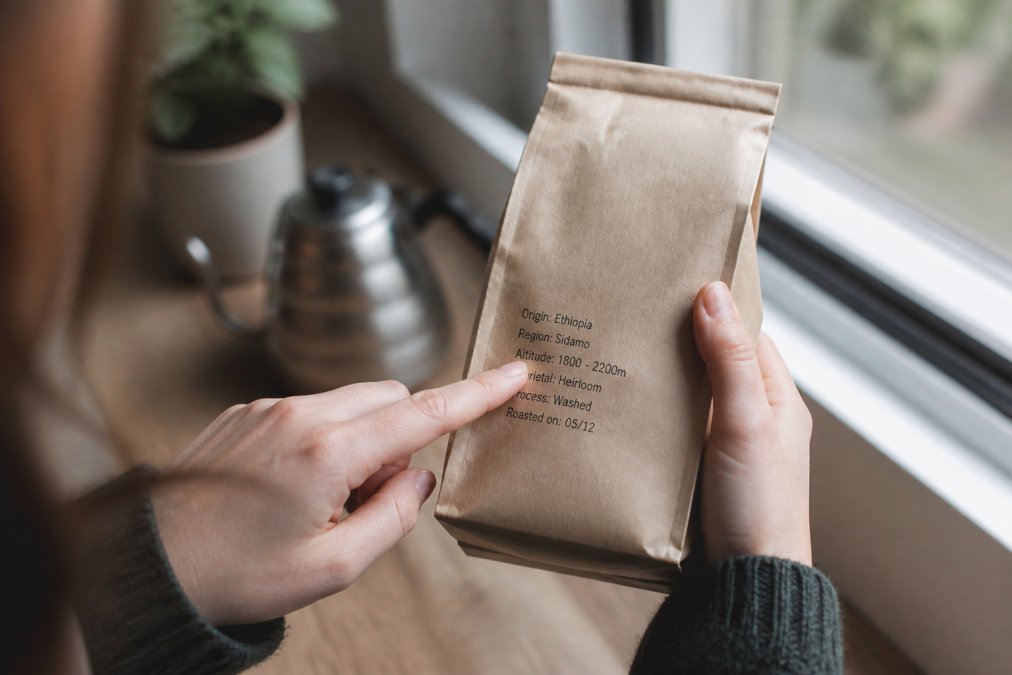
Origin specificity means a farm, cooperative, or region, not just a country. Altitude, given in meters, indicates growing conditions and generally correlates with quality. Process tells you how the cherry was handled, whether fully washed, natural, or wet-hulled.
Then check the certification logo itself. A real mark has a recognizable design, and you can verify the roaster's claim through Fairtrade America's certified product directory or the certifier's own lookup tool.
Follow the Money: Importers, Cooperatives, and Farm-Gate Price
Farm-gate price is what a farmer receives for raw coffee at the farm before export, milling, shipping, or roasting costs. It's the single number that reveals whether an ethical premium reaches the grower. Almost no brand puts it on the bag, which is exactly why you have to ask.
The Middleman Nobody Talks About
Most guides frame the supply chain as farm-to-roaster and skip the importer entirely. In reality, the importer sits between the two and often controls the number that determines whether a farmer gets paid fairly. Importers handle export logistics, customs, warehousing, milling, and financing, and are frequently the only party with a complete view of what was paid at origin. Some publish annual transparency reports listing the price paid above the commodity benchmark, the farm or cooperative name, and the volume purchased. Others don't, and that opacity is where ethical premiums quietly disappear. A roaster can sincerely believe it pays a premium while its importer captures most of the spread.
This is why "we buy direct" and "we pay above market" are weak claims on their own. The verifiable version names the importer and the price. Ask a roaster two questions: who imports your green coffee, and what did you pay above the commodity price last year? A roaster with real supply chain transparency answers without hesitation. A roaster that deflects to a farm visit story does not have the number.
A Rough Breakdown of Where Your Money Goes
Exact figures vary by origin, harvest, and quality, but the general shape of a retail dollar is consistent. On a typical bag of specialty coffee, the largest share goes to roasting, packaging, marketing, and retail margin combined. Green coffee cost, what the farmer was paid plus export, shipping, and importer margin, is a minority of the retail price, and the farmer's share of that is smaller still. That's the uncomfortable math behind "ethical premium": a few cents per pound above the commodity benchmark can be a meaningful income increase for a smallholder and a rounding error in the retail price. A roaster claiming to pay one should be able to show the number, because it costs little to disclose and matters greatly at origin.
Why Cooperatives Are the Accountability Layer
Cooperatives matter for the same reason importers do. A well-run cooperative aggregates smallholder harvests, negotiates collectively, and distributes premiums through recorded payments. One that exists on paper only, without member records or meeting minutes, is a pass-through entity that can absorb a premium without distributing it. Fair Trade certification is built around cooperatives for this reason, which is also its limitation: smallholders outside a cooperative structure are excluded from the price floor entirely.
What Real Transparency Looks Like
A roaster with genuine supply chain visibility can tell you, without research, the farm or cooperative name, the region, the importer, the harvest year, and a price relationship to the commodity benchmark. If any of those five is missing, the sourcing claim is a story, not a record.
Paws and Promise Coffee takes a different route to accountability: 10% of every order is donated to support the Forever Paws Animal Shelter and Sweet Inspirations' supportive employment programs in Milford, MA. That's a verifiable commitment you can hold us to, separate from any sourcing claim on a bag. Our single origins, including Bali Blue and Ethiopia Natural, name the growing region, altitude, and process on every label, and we roast to order so the coffee arrives at peak flavor.


Conclusion: Trust the Details, Not the Story
Coffee marketing rewards good storytelling, which is exactly why you should ignore the story and read the details. Certification marks, named farms, published altitudes, and roast dates are hard to fake. Adjectives are easy. Next time you pick up a bag, run the four-point visual audit and ask who verified the claim. If the answer is "the roaster says so," you have your answer.
Frequently Asked Questions
What are the most reliable third-party coffee certifications?
Fair Trade Certified, USDA Organic, and Bird Friendly (Smithsonian) are the most rigorous. Fair Trade sets a minimum price and requires cooperative governance. USDA Organic verifies no prohibited pesticides and includes buffer zones for bird habitat. Bird Friendly requires shade-grown, organic farms with documented canopy cover. Rainforest Alliance is credible but less strict on price guarantees. A bag carrying two or more of these certifications is a stronger signal than a single logo.
What is the difference between Fair Trade and Direct Trade coffee?
Fair Trade uses a third-party certifier that audits cooperatives, guarantees a minimum price, and collects a social premium for community projects. Direct Trade skips the certifier: the roaster negotiates directly with farmers, often paying above Fair Trade rates. The catch is accountability. Direct Trade has no independent audit, so the roaster's own claims are the only proof. Fair Trade is verifiable; Direct Trade depends on trust. Ask a Direct Trade roaster for farm names, prices paid, and visit records.
How can I tell if a coffee brand is practicing greenwashing?
Watch for vague phrases like "sustainably sourced," "eco-friendly," or "farm-direct" with no certifier named, no farm names, and no prices disclosed. Legitimate brands name the cooperative, the region, and the altitude. They link to audit reports or certification numbers. If a bag uses a green leaf icon that is not a recognized certification mark, that is decoration, not verification. Check the roaster's website for an impact page with specific numbers, not just photos of farmers.
What should I look for on a coffee bag to ensure ethical sourcing?
Look for four things: a recognized certification logo (Fair Trade, USDA Organic, Bird Friendly), the specific farm or cooperative name, the region and altitude, and the processing method. Then check the roaster's website for a transparency report listing farm-gate prices or premiums paid. Brands that publish this information are accountable. Brands that only show a smiling farmer photo and the word "ethical" are not. Paws and Promise Coffee, for example, publishes its origin details and donates 10% of every order to support the Forever Paws Animal Shelter and Sweet Inspirations' supportive employment programs in Milford, MA.
Paws and Promise Coffee exists because we believe a daily cup should do more than taste good. Every order supports rescue animals and inclusive employment, every bag is roasted to order for freshness you can taste, and every label tells you exactly where the coffee came from. Get started with Paws and Promise Coffee and make your morning coffee mean something.