

Table of Contents
- Why Fresh Roasted Coffee Beans Delivery in Massachusetts Changes Everything
- How to Store Fresh Roasted Coffee After Delivery
- The Benefits of Ethically Sourced Coffee
- Specialty Coffee vs Grocery Store Coffee: What You're Actually Paying For
- Price-Per-Ounce and Shipping: The Real Cost of Fresh Roasted Coffee Delivery
- Choosing Your Roast: Whole Bean, Ground, Pods, and Instant
- Sustainability, Packaging, and Local Impact in Massachusetts
- Conclusion
- Frequently Asked Questions
Last Updated: September 17, 2026
Why Fresh Roasted Coffee Beans Delivery in Massachusetts Changes Everything
Fresh roasted coffee beans delivery in Massachusetts means ordering from a roaster who roasts to order and ships straight to your door, so beans arrive days after roasting rather than months after. Freshly roasted beans still hold the volatile oils and gases that carry aroma, and those fade quickly once a bag is opened. This guide from Paws and Promise Coffee covers what to look for, what it costs, and how to keep a delivered bag tasting its best.
Most supermarket coffee sits in a warehouse, then a distribution center, then a shelf, so by brew time the roast date is often months old or missing.
That gap is the argument for ordering direct: a roaster who ships small-batch coffee the same week it leaves the drum gives you what grocery aisles cannot.
How to Store Fresh Roasted Coffee After Delivery
Store fresh roasted coffee in an airtight, opaque container at room temperature, away from light, heat, and moisture, and grind just before brewing. Whole bean holds its character far longer than pre-ground because less surface area meets oxygen.
A few practical rules that make a measurable difference:
- Keep the bag's one-way degassing valve intact if you store beans in the original packaging; it releases carbon dioxide without letting oxygen in.
- Skip the fridge. Condensation cycles on and off the beans every time you open the door.
- Skip the freezer unless you're storing a bulk bag you won't touch for weeks. If you do freeze, portion first and never refreeze.
- Buy in a size you'll finish in two to three weeks. A 12 oz bag suits most single-drinker households; a 2 lb bag suits a household brewing multiple pots a day.
Light also degrades coffee oils faster than most people expect, which is why clear glass jars on an open shelf look great and perform poorly.
The Benefits of Ethically Sourced Coffee
Ethically sourced coffee is purchased through channels that pay producers above commodity rates and invest in farming communities, yielding better lot selection, more traceable origins, and a supply chain a roaster can describe. But the term has no single legal definition, and a roaster can print it without proving anything.
So the useful question isn't whether a roaster uses the phrase. It's which verification mechanism sits behind it. There are four, and they are not equally strong.
Third-party certification. Fair-trade and organic certifications are verified by outside auditors, so an independent party confirms the claim.
Paws and Promise Coffee takes the fourth route: 10% of every order goes to two named causes, 5% to Forever Paws Animal Shelter in Fall River and 5% to Sweet Inspirations in Milford, a nonprofit creating meaningful jobs for adults with intellectual disabilities. That's a verifiable commitment, and it gives the daily coffee purchase a second purpose you can track.
Specialty Coffee vs Grocery Store Coffee: What You're Actually Paying For
Specialty coffee scores 80 points or higher on the industry's 100-point scale, judged on sweetness, acidity, body, and clean cup character. Grocery store coffee is typically commodity-grade, blended for consistency across huge volumes, and priced to hit a shelf position rather than a flavor target.
- Green coffee cost. Specialty lots cost the roaster more per pound before roasting even starts.
- Roast date transparency. A roaster shipping direct prints the roast date because it's a selling point. Mass-market brands often print only a "best by" date, which tells you when to stop, not when the coffee peaked.
- Batch size. Small-batch roasting means tighter control and more labor per pound, which is exactly why the output tastes more specific.
Price-Per-Ounce and Shipping: The Real Cost of Fresh Roasted Coffee Delivery
The real cost of fresh roasted coffee delivery is price per ounce plus shipping, divided by how much of the bag you actually drink before it goes stale. Most comparisons stop at the sticker price and miss that second half.
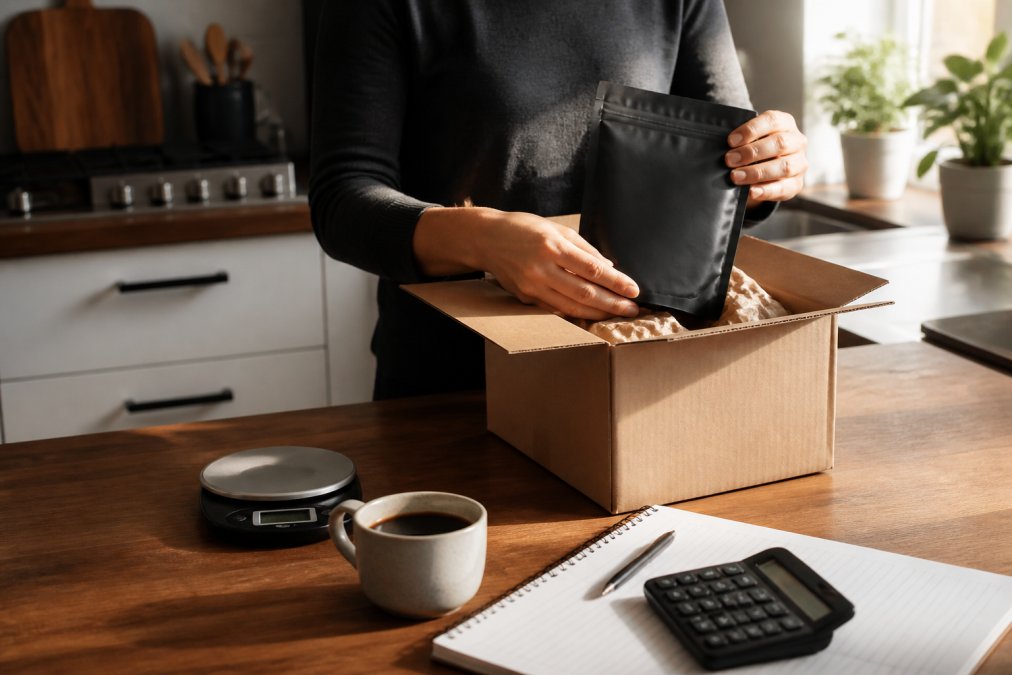
Run the numbers on a few real options:
| Product | Price | Size | Price Per Ounce | Shipping |
|---|---|---|---|---|
| Breakfast Blend | $22.99 | 12 oz | $1.92 | Free (U.S.) |
| House Blend | $22.49 | 12 oz | $1.87 | Free (U.S.) |
| Cold Brew Blend | $20.10 | 12 oz | $1.68 | Free (U.S.) |
| Instant Coffee (30 servings) | $19.85 | 3 oz pouch | $6.62 | Free (U.S.) |
| Original Roast Capsules (12 pack) | $19.99 | 12 pods | $1.67 per pod | Free (U.S.) |
| Original Roast Capsules (60 pack) | $69.99 | 60 pods | $1.17 per pod | Free (U.S.) |
Choosing Your Roast: Whole Bean, Ground, Pods, and Instant
Choose whole bean if you own a grinder and want maximum flavor; ground if convenience matters more; pods or instant if speed and consistency outweigh the last few points of cup quality. Format is only half the decision, the other half, which most buying guides skip, is matching roast profile to brewing method.

Match the roast to the brew, not just the grind
Grind size is the first variable, but roast level is the second, and it changes how a bean behaves in a given device. A few patterns hold across most setups:
-
Light roasts are denser and less soluble, so they reward methods with longer contact time and hotter water: pour-over, drip, and AeroPress. In a French press they can taste thin and acidic if the steep is short. In an espresso machine they're the hardest to dial in because the density resists extraction.
-
Medium roasts are the most forgiving across methods. They work in drip, pour-over, French press, and espresso without demanding much adjustment, which is why they're the common default for households that brew more than one way.
-
Dark roasts are more porous and extract faster, so they shine in French press, cold brew, and espresso, where a shorter or gentler extraction keeps the roast from turning bitter. In a drip brewer with a long cycle, a dark roast can tip toward ash if the grind is too fine.
-
Cold brew is the most forgiving of all: coarse grind, long steep, and almost any roast works, though dark and medium roasts tend to produce the roundest concentrate.
-
French press and cold brew: coarse grind, medium to dark roast
-
Drip brewer: standard grind, medium roast
-
Espresso machine or moka pot: fine grind, medium to dark roast
-
Pour-over: medium-fine grind, light to medium roast
A practical way to test your match
Buy a sample pack before committing to a full bag, and brew the same bean two ways in one week. If the pour-over tastes flat and the French press sweet, you've found your method for that roast; if both taste bitter, the grind is too fine or the water too hot.

Sustainability, Packaging, and Local Impact in Massachusetts
Sustainability in coffee comes down to three things you can evaluate: how the beans were grown, what the packaging is made of, and where the money lands after you pay. The third is the most overlooked and often the easiest to verify.
Conclusion
The hard part of buying coffee online isn't finding a roaster, it's whether the freshness claim, shipping cost, and sourcing story hold up once the box arrives. Most of the value sits in details a product page rarely spells out: roast date, price per ounce, and where the money goes.
Frequently Asked Questions
How do I know if my coffee beans are fresh?
Check the roasting date on the bag, not just the best-by date. Fresh roasted coffee peaks between 4 and 14 days after roasting. You can also look for bloom: pour hot water over a scoop of grounds and if it puffs up and bubbles, the beans are releasing carbon dioxide and still fresh. Bags with a one-way degassing valve and a roast date printed on the label are your best signal.
What is the benefit of buying coffee roasted to order?
Roast-to-order coffee is roasted after you buy it, not weeks before it hits a shelf. That means it arrives at peak flavor instead of already going stale. Oxygen and time are the two biggest enemies of coffee, and roast-to-order shortens the gap between the roaster and your kitchen. Paws and Promise Coffee roasts in small batches and ships fresh, so the bag you open is close to its roasting date.
How long do fresh roasted coffee beans stay fresh after delivery?
Whole bean coffee holds peak flavor for about two to four weeks after the roast date. Pre-ground coffee fades faster, often within a week, because more surface area is exposed to air. For the best cup, buy whole bean and grind right before brewing. If you buy ground, choose a bag size you will finish within a week or two and reseal it tightly after every use.
Does local coffee delivery save money compared to grocery store brands?
It can, once you compare price per ounce instead of price per bag. Grocery brands often sell larger bags, but you are paying for coffee roasted months earlier. Fresh roasted coffee beans delivery in Massachusetts ranges from about $19.85 for a 30-serving instant pouch to $22.99 for a 12 oz bag of Breakfast Blend, with free shipping on all U.S. orders. Do the math on ounces and servings before you decide.
How should I store my coffee beans after delivery?
Keep beans in an airtight, opaque container at room temperature, away from light, heat, and moisture. Do not store them in the fridge, where condensation and odors creep in. The freezer works only if you seal the bag tight and use it in small batches. Buy a bag size you will finish in two to four weeks, and keep the original degassing valve bag if it reseals well.