

Table of Contents
- Why Order Fresh Roasted Coffee Online Beats Store-Bought
- Coffee Roast Dates Explained: What the Date on the Bag Tells You
- Whole Bean vs. Ground Coffee: Which Ships Better
- Single-Origin vs. Blends: Picking Your Flavor Profile
- How to Store Fresh Roasted Coffee After Delivery
- Pricing and Shipping: What Ordering Fresh Roasted Coffee Online Costs
- Conclusion
- Frequently Asked Questions
Last Updated: September 13, 2026
Why Order Fresh Roasted Coffee Online Beats Store-Bought
Fresh roasted coffee is coffee that reaches you within days of roasting, not months, and that gap is the entire difference between a lively cup and a flat one. When you order fresh roasted coffee online from a roast-to-order operation, the beans are roasted after you buy them, not before. At Paws and Promise Coffee, we roast to order for exactly this reason, and 10% of every sale supports Forever Paws Animal Shelter and Sweet Inspirations' employment programs in Milford, MA.
Grocery shelves work against freshness. Bagged coffee may sit in a warehouse, then a distribution center, then a store shelf before it ever reaches your kitchen. Oxygen is the enemy here: once roasted beans meet air, they begin losing the aromatics that make coffee taste like coffee. Nitrogen-sealed packaging and a visible roast date are the two signals worth trusting.
Below, we'll show you exactly how to read a roast date, choose between whole bean and ground, pick a flavor profile, store what you buy, and understand what shipping actually costs.
Coffee Roast Dates Explained: What the Date on the Bag Tells You
The roast date is the day the beans came out of the roaster, and it matters far more than a "best by" date. A best-by date is a quality estimate the seller sets; a roast date is a fact about the product. When you order fresh roasted coffee online, the roast date is the single most useful number printed on the bag.
The Freshness Curve: Why the First Days Matter Most
Roasted coffee does not go stale in a straight line. It follows a curve with three rough phases:
- Days 1-3 after roast, rest. The beans are still releasing carbon dioxide fast. Brew too soon and the escaping gas disrupts water contact with the grounds, producing uneven extraction and a cup that tastes sharp or hollow.
- Days 4-14, peak window. Degassing has slowed enough for consistent extraction, but the aromatic oils and volatile compounds that carry origin character are still largely intact. For most roast levels, this is the sweet spot.
- Beyond 2-3 weeks, decline. Oxidation and moisture exposure steadily mute aromatics. The coffee is still drinkable, but the brightness and complexity you paid for fade.
Degassing is the mechanism behind all of this. Carbon dioxide, generated during roasting, escapes from the bean over days (PubMed). It is why a freshly roasted bag puffs up, why one-way degassing valves exist on quality packaging, and why roasters generally recommend letting beans rest a few days post-roast before brewing. Darker roasts degas faster and tend to peak sooner; lighter roasts can need a longer rest.
How to Read a Bag Like a Roaster
What to look for on any bag:
- A printed roast date, not just a lot code or a "packed on" date
- A roast level (light, medium, or dark)
- Origin or blend information
- Whether it's whole bean or ground
- A one-way valve, which lets CO2 out without letting oxygen in
A "best by" date alone tells you nothing about how old the coffee actually is. If a bag shows no roast date at all, assume the coffee is older than you'd like. Roast date transparency is one of the clearest signs of a roaster who stands behind freshness.
The Shipping Math
Roast date only helps if shipping is fast enough. A bean roasted Monday and delivered the following week has already spent most of its peak window in transit. That is why roast-to-order operations, where beans are roasted after you buy, not before, tend to deliver a fresher cup than warehouse-stocked retail. When you order, check two things: the stated roast-to-ship turnaround, and the carrier transit time to your ZIP code. Together they tell you roughly what day the coffee will land relative to its roast date.
Whole Bean vs. Ground Coffee: Which Ships Better
Whole bean coffee ships better and stays fresh longer, because the bean's surface area is smaller and its oils stay protected. Grinding exposes those oils to oxygen immediately, which is why pre-ground coffee stales faster.
That said, ground coffee isn't a bad choice if you don't own a grinder or you're buying single-serve capsules. Convenience has real value, especially for busy mornings.
| Format | Freshness Window | Best For | Grind Control |
|---|---|---|---|
| Whole bean | Longest | Home grinders, pour-over, French press | Full control |
| Pre-ground | Shorter | Drip machines, no grinder on hand | Set by roaster |
| Single-serve capsules | Sealed until brewed | Offices, travel, quick mornings | Fixed |
A common mistake is buying whole bean coffee and then grinding an entire bag at once. Grind what you'll brew in the next day or two and leave the rest whole.
Single-Origin vs. Blends: Picking Your Flavor Profile
Single-origin coffee comes from one region or farm, while a blend combines beans from multiple sources. Single-origin beans showcase a specific flavor profile: the tasting notes, acidity, body, and aroma that reflect where the coffee grew.

Blends exist for consistency. A roaster can balance beans from different harvests to keep a house flavor steady year-round, which is why blends dominate restaurant and office coffee.
Processing method also shapes what you taste. Washed process coffees tend to be cleaner and brighter; natural process coffees often taste fruitier and heavier; honey process sits between the two.
How to decide:
- Want to explore regional character? Start with single-origin.
- Want a dependable everyday cup? Choose a blend.
- Unsure? A medium roast blend is the safest starting point.
Arabica beans dominate specialty coffee for good reason: they generally carry more sweetness and complexity than other varieties, and they're what you'll find in most single-origin offerings (PubMed).
How to Store Fresh Roasted Coffee After Delivery
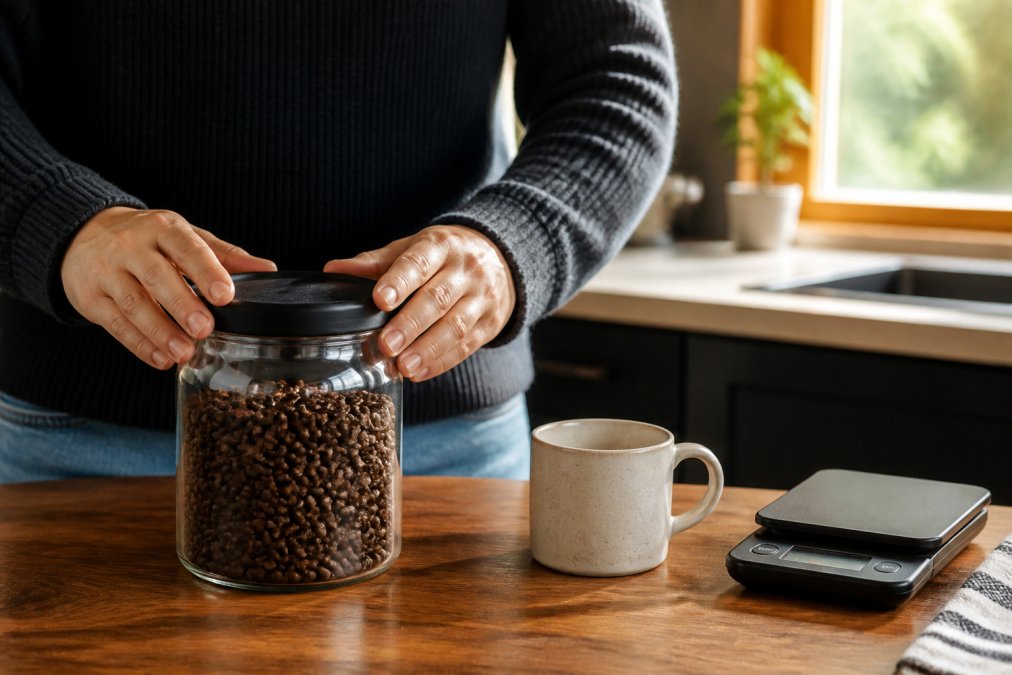
Storage is where most of your freshness advantage is won or lost. The four enemies of roasted coffee are oxygen, light, heat, and moisture, and every good storage habit maps to one of them.
The Container
- Airtight. Oxygen drives oxidation, which is the main pathway to stale flavor. A container with a real gasket seal beats a folded bag clip.
- Opaque. Light accelerates degradation of the oils on the bean surface. A clear jar on an open shelf is worse than a solid canister in a cabinet.
- One-way valve if you keep the original bag. Quality coffee bags are designed to let CO2 escape while limiting oxygen ingress. If you reseal the bag, press out excess air first.
The Location
Store coffee at room temperature, in a dark cabinet, away from the stove, oven, or any heat source. Heat speeds up every chemical reaction that flattens flavor.
The Freezer Question
The refrigerator is the wrong tool for daily-use coffee: opening the door cycles temperature and humidity, and coffee absorbs odors from whatever else is in there (peer-reviewed research). The freezer is a different story, it can work for long-term backup, but only if you do it right:
- Freeze whole beans, not ground coffee
- Portion into airtight, freezer-safe bags so you thaw only what you'll use
- Let the sealed portion come to room temperature before opening, to avoid condensation on the beans
- Do not refreeze the same coffee repeatedly
For most households, buying smaller amounts more often beats stockpiling. It is the simplest way to guarantee every cup tastes fresh.
Grind Timing
Grinding exposes far more surface area to oxygen, so pre-ground coffee stales much faster than whole bean. Grind what you'll brew in the next day or two and leave the rest whole. If you buy pre-ground for convenience, buy smaller bags and reseal them tightly after each use.
A Simple Storage Checklist
- Keep beans whole until you brew
- Use an airtight, opaque container at room temperature
- Buy in quantities you'll finish within a few weeks
- Reseal bags tightly if you don't transfer to a container
- Skip the fridge; use the freezer only for sealed, portioned backup
Pricing and Shipping: What Ordering Fresh Roasted Coffee Online Costs
What you pay depends on format and quantity, and the per-cup math usually favors larger packs. Here's how our own pricing breaks down:
| Product | Price | Format | Best For |
|---|---|---|---|
| Original Roast Single Serve Capsules (12 Pack) | $19.99 | K-Cup compatible | Trying capsules for the first time |
| Original Roast Single Serve Capsules (60 Pack) | $69.99 | K-Cup compatible | Offices and family kitchens |
| Instant Coffee (30 Servings) | $19.85 | Resealable pouch | Travel, camping, desk drawers |
| The Daily Brew Starter Pack | $39.99 | 12 oz bag + mug | Gifting and first-time buyers |
Shipping policy matters as much as price. Before ordering, confirm whether the roaster ships nationwide, how orders are packed, and whether a freshness guarantee applies. The Daily Brew Starter Pack ships free, which makes it a reasonable entry point if you want to test a roaster before committing to a larger order.

Conclusion
The hardest part of buying coffee online isn't finding a roaster, it's finding one that tells you the roast date and ships fast enough for it to matter. Freshness is a logistics problem, and most of the flavor you're paying for depends on how quickly beans move from roaster to doorstep.
Paws and Promise Coffee roasts to order, seals capsules with no oxygen inside, and donates 10% of every sale to Forever Paws Animal Shelter and Sweet Inspirations. You get ethically sourced coffee and a purchase that does something beyond your mug. Add to cart and taste what roast-to-order actually means.
Frequently Asked Questions
How can you tell if coffee beans are truly fresh?
Check the roast date, not the expiration date. Fresh roasted coffee tastes best within 2 to 4 weeks of roasting. Look for a printed roast date on the bag, a one-way degassing valve, and a strong aroma when you open it. Beans that look oily and smell flat are usually past their peak, while recently roasted beans feel dense and smell sweet.
How long does fresh roasted coffee stay fresh after delivery?
Whole bean coffee holds peak flavor for about 2 to 4 weeks after the roast date. Ground coffee loses aroma faster, often within 1 to 2 weeks, because more surface area is exposed to oxygen. Store beans in an airtight container away from light and heat, and only grind what you plan to brew that day for the best cup.
What should I look for on a coffee bag label to ensure freshness?
Look for a roast date, the origin or blend name, the processing method, and tasting notes. A one-way degassing valve means the roaster packaged it to release carbon dioxide without letting oxygen in. If a bag only shows a best-by date with no roast date, you cannot verify how long it has sat on a shelf.
Does buying coffee online save money compared to local shops?
Online ordering often costs less per cup because you skip retail markup, and larger packs lower the per-serving price. For example, a 60-pack of single-serve capsules at $69.99 works out to about $1.17 per cup, while a 12-pack at $19.99 runs about $1.67 per cup. Subscriptions and free shipping thresholds cut costs further.